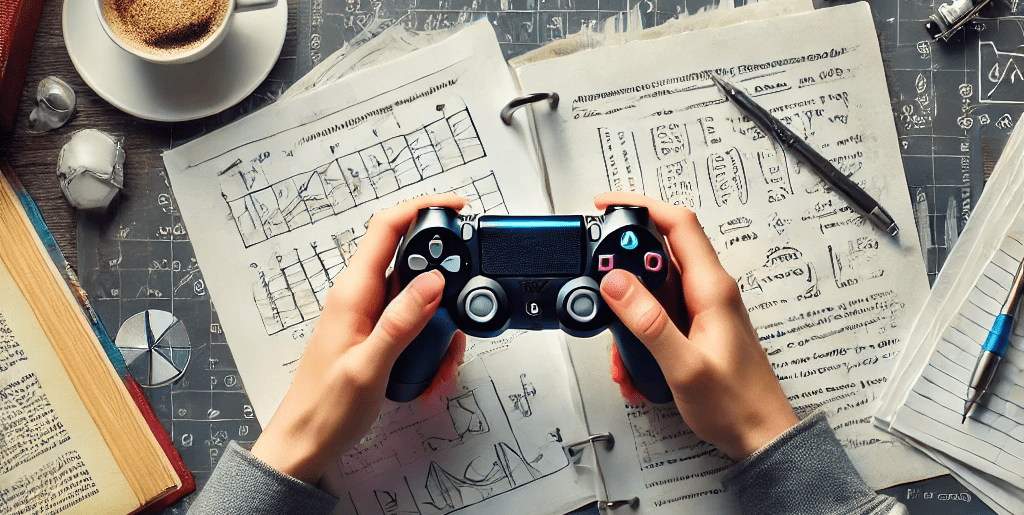
As you can probably tell from the uncanny valley AI-generated blog post image, I fall on the side of optimism when it comes to new technologies. New technologies force us to question our traditional approaches, while at the same time providing new and exciting opportunities for what we can do in our lives and occupations. I, for one, think it’s a lot of fun!
Not to say that new technologies don’t come with their share of challenges and threats to established society, of course. The challenges that many sectors currently face due to the proverbial explosion in access to generative AI – including the research and education sector – illustrates this very clearly, and there’s no shortage of good arguments for more regulation of technological development. Arguments, which I tend to agree with. Nevertheless, whenever I’m given the opportunity to utilize a new technology, the excitement of being able to do something I wasn’t able to do before tends to overshadow my apprehension.
This excitement is no less present in my practice as an early-career lecturer in higher education. With new technologies and educational approaches, be it ChatGPT, gamification, or flipped classrooms, I believe that we’ll be able to communicate more efficiently with our students, both through better alignment with their technological reality and through more interactivity in and outside the classroom. In this blog post, I’ll discuss the advantages – but also the limitations – of gamification approaches in education by way of two examples: interactive videos and serious games.
Interactive videos usually fall under the category of supplementary materials. Even though my own first interactive videos were standalone refresher courses, which I’ve developed as part of my employment with Leiden University, I mainly see interactive videos as a great tool to provide students with additional materials and let them test their own knowledge outside of the classroom. For the uninitiated, an interactive video can fall anywhere on the scale between a slide show with videos and a video game-style decision tree complete with choice-based “gameplay”. In its simplest conception, an interactive video is simply a video, in which you implement pauses (“Press this button to continue”) or test the student’s knowledge (“Press this button to hear the answer”) at strategic moments. More complex interactive videos can have multiple pathways and let the student explore the topics that appeal to them the most – think of ‘Choose your own adventure’ books or the episode Bandersnatch from the Netflix show Black Mirror. Further, this design forces the student to engage with the video, which not only means that they can’t leave it running in the background, but it may also make it easier for students with concentration impairments to process the material. Finally, added agency may simply make the learning experience more enjoyable.

So, with all this great functionality, why does the title of this blog post suggest that I’m also a bit of a skeptic? Well, while gamification approaches within higher education such as interactive videos often make the learning experience easier for students, this may not always be a good thing. Let’s look at some of the skills valued in a university graduate (see, for instance, Hernández et al. 2009 or Gruzdev et al. 2018): critical thinking, independent learning, time management, creativity, communication, and teamwork. What these skills all have in common is that they can only be learned when there is a certain dissonance in clarity between the outcome and the steps involved to reach the outcome. Put differently, sometimes good learning involves the student knowing where to go without knowing how to get there. In order to build good time management skills, for instance, one has to be put in situations where one has to finish a number of tasks within a certain amount of time, but without clear guidance on the time each task takes, or the order, in which they’re most efficiently done. Similarly, to become a critical thinker one must be exposed to topic material without a manual on what to look for to determine the credibility or quality of the material in question. In my opinion, this marks the limitation of interactive videos: while they’re great tools to support students with the lower levels of Bloom’s taxonomy, they should never replace or interfere with activities developing more advanced skills.
Does this mean, then, that gamification is only good for memorizing and understanding, and that everything else needs to be taught by a lecturer monologuing for 3 hours, while the students take notes? This is where serious games, as well as similar approaches, come into play. Serious games, a still very young addition to the higher education curriculum, are games, mostly conducted at a class-level, developed, not with the primary goal of entertainment, but of education, I use the term serious game here to refer to simulations, in which students are assigned different roles with predetermined aims and put in a conflict or problem-solving situation, and which have sufficient game mechanics to allow a winner to be declared. An example of a serious game, which has been around for a long time, is Model UN. The serious game, then, usually provides the players with clear goals but not a clear path to victory. In order to win, players will have to negotiate, make alliances, deflect blame, and agree on compromises, all while taking the behavioral patterns of other players into account. As such, gamification approaches such as serious games can be excellent ways to teach students skills like creativity, critical thinking, teamwork, or communication.
One caveat to my previous extolment of the serious game, is that it is only truly valuable as a teaching tool with thorough subsequent debriefing and reflection. In fact, some even argue that a serious game without debriefing is unethical, because students may leave the game as “confident incompetents” – a sentiment, which I tend to agree with. The debriefing and reflection of a serious game is where the student has the opportunity to reflect on what they learned in the game (and what the limitations of those learning points are) and consolidate that knowledge with their existing knowledge base. This requires critical thinking and reflection of the students as well as speedy analysis and knowledge consolidation of the lecturers. As such, the serious game is no less demanding of the lecturer than a traditional lecture, and without this awareness, I can see the potential for misapplication. On the other hand, this is equally true of traditional didactic lectures, which are unlikely to promote any sort of critical thinking or creativity, if the students are told to simply listen and take notes.
In summary, what is the value of gamification in education? Gamification approaches give us some additional tools to facilitate the acquisition of different skills and supplement our existing curricula. They can help us support students with various learning needs, and they can even promote the core skills that we want to nurture within higher learning. Ultimately, however, they don’t – or at least shouldn’t – fundamentally change the essence of higher education. And, just as the traditional didactic lecture format is unhelpful in excess, so are gamification elements. While I still think all lecturers should give interactive videos or serious games a try, they should thus do so in moderation and with an eye for the skills their chosen approaches are promoting.
 Sara Perlstein, MSc